
Why Large Companies Invest in AI: The Growth Playbook
Why Large Companies Invest in AI: The Growth Playbook
Large companies invest in AI primarily to drive innovation and growth, not simply to cut costs. That distinction matters more than most executives realize. Deloitte found that 40% of companies reduced costs with AI, while only 20% increased revenues. The firms that focus on revenue growth and new product development consistently outperform those chasing efficiency alone on both stock performance and employment growth. Understanding why large companies invest in AI means understanding that the real prize is competitive advantage built on proprietary data, redesigned workflows, and organizational commitment from the top down.
Why large companies invest in AI for innovation, not just savings
The dominant narrative around AI adoption focuses on cost reduction. The data tells a different story. Bain CFOs report that speed and cycle-time reduction rank as the primary AI win at 48%, while cost savings trail at 34%. Speed is an innovation metric, not an efficiency metric. It means faster product launches, shorter feedback loops, and the ability to outpace competitors who are still running annual planning cycles.
Innovation-led AI applications take several concrete forms in large enterprises:
- New product development: AI models analyze customer behavior data to identify unmet needs and generate product concepts faster than traditional research methods.
- Faster development cycles: Generative AI coding assistants compress software development timelines, letting engineering teams ship features in weeks rather than quarters.
- Premium service tiers: Financial services firms use AI to deliver personalized advice at scale, creating service offerings that were previously only available to high-net-worth clients.
- Market expansion: AI-powered translation and localization tools let companies enter new geographic markets without proportional headcount increases.
The companies winning with AI treat it as a product capability, not a back-office tool. They assign AI initiatives to business unit leaders, not IT departments, and they measure success in revenue terms.
Pro Tip: Assign every AI initiative a revenue or growth hypothesis before it starts. If you cannot articulate how the initiative creates customer value or opens a new market, it belongs in a cost-reduction bucket, not an innovation portfolio.

How AI enables scalability in large enterprises
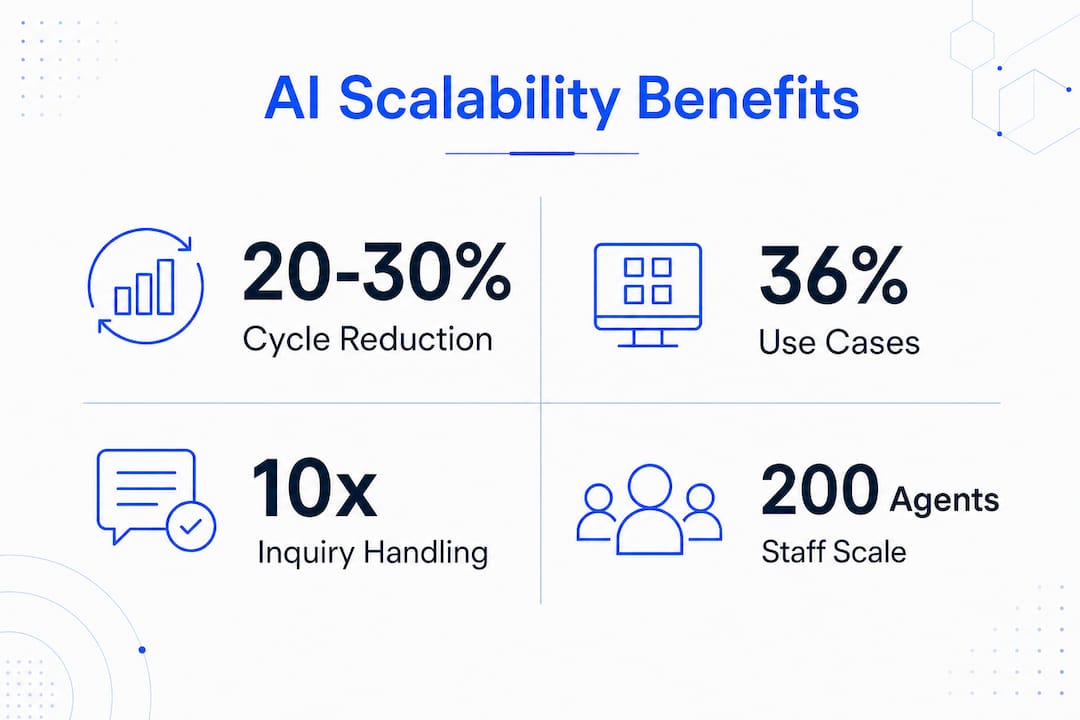
Scalability is the second major reason large companies commit capital to AI. About 36% of AI use cases cite scalability as the primary strategic driver. That figure reflects a fundamental shift in how enterprises think about growth. Traditional scaling required proportional increases in headcount, infrastructure, and management overhead. AI breaks that relationship.
A customer service operation that handles 10,000 inquiries per day with 200 agents can, with well-designed AI agents, handle 100,000 inquiries without hiring 2,000 more people. The unit economics change entirely. The same logic applies to software testing, financial reporting, compliance monitoring, and dozens of other high-volume enterprise functions.
The operational numbers support this. AI-driven workflow modernization delivers 20–30% shorter software development cycles and 10–30% reductions in software maintenance and licensing costs. Those are not marginal gains. A large enterprise spending $500 million annually on software operations can redirect $50–150 million toward growth initiatives.
| AI application area | Primary scalability benefit | Typical efficiency gain |
|---|---|---|
| Software development | Faster feature delivery | 20–30% shorter cycles |
| IT portfolio management | Reduced licensing overhead | 10–30% cost reduction |
| Customer service automation | Higher volume without headcount growth | Scalable to demand peaks |
| Compliance monitoring | Continuous coverage vs. periodic audits | Near-real-time risk detection |
Pro Tip: Before deploying AI for scalability, map your current process end-to-end and identify where manual handoffs create bottlenecks. AI scales what already works. It amplifies what does not.
Why proprietary data and leadership commitment define AI winners
The most durable competitive advantages from AI do not come from buying the same tools every competitor can access. They come from proprietary intelligence. Bain identifies seven critical capabilities for winning with AI, including CEO commitment, domain focus, data architecture, and governance. Each capability compounds the others. A company with unique customer data, encoded workflows, and a learning architecture that improves with every transaction builds a moat that is genuinely hard to replicate.
A Harvard Business School study confirms this dynamic. Incumbents with rich data capital gain substantially higher returns from generative AI than startups or new entrants. Large companies already hold the raw material for AI advantage. The question is whether they activate it deliberately.
Building proprietary AI intelligence requires three sequential steps:
- Audit your data assets. Identify what data you own that competitors cannot easily replicate. Transaction histories, customer interaction logs, and operational sensor data are common examples. An AI data strategy framework helps you assess which assets carry the most competitive weight.
- Encode your best workflows. The judgment calls your top performers make every day represent institutional knowledge. AI systems trained on those decisions capture expertise that would otherwise walk out the door with retirements and departures.
- Build learning loops. Design AI systems that improve with use. Every customer interaction, every transaction, every operational decision should feed back into the model. Over time, the system becomes more accurate than any competitor starting from scratch.
Leadership commitment is not optional in this process. Vanguard’s approach treats AI as a business strategy, deploying AI champions across divisions to prioritize use cases and maintain focus on measurable ROI. That structure prevents AI from fragmenting into dozens of disconnected pilots that never reach scale. The CEO sets the direction. Division leaders own the outcomes. AI champions connect the two.
Workforce modernization runs parallel to all of this. Redesigning job roles to work alongside AI agents, rather than expecting full automation, produces better results and faster adoption. Employees who understand how AI augments their work become advocates. Those who feel replaced by it become obstacles.
What separates AI success from expensive failure
Most large companies have run AI pilots. Far fewer have scaled them. Less than 20% of companies have scaled generative AI meaningfully. The gap between pilot and scale is where most AI investment value disappears.
The root cause is almost always the same: companies layer AI tools onto existing broken processes instead of redesigning those processes around AI capabilities. Bain’s research shows that AI amplifies existing process inefficiencies when deployed without cleanup and redesign. A slow, error-prone approval workflow does not become fast and accurate because you add an AI layer on top. It becomes a fast, error-prone workflow with an AI veneer.
The practices that separate successful AI scaling from expensive failure include:
- Start with a clean-slate workflow design. Ask what the process would look like if you built it today with AI as a native component, not an add-on.
- Set measurable hypotheses before deployment. Define what success looks like in business terms: revenue generated, time saved, error rate reduced. If the initiative does not hit its hypothesis within a defined period, stop it and reallocate resources.
- Scale what works, kill what does not. Satisfaction rates jump from 25% in the pilot phase to 41% when AI is scaled, and reach 60% in the most AI-mature organizations. The data argues for moving fast from pilot to scale on winning use cases.
- Distribute AI champions. Centralized AI teams create bottlenecks. Embedding AI-literate leaders in each business unit accelerates adoption and surfaces use cases that central teams would never identify.
- Manage the portfolio ruthlessly. Successful AI transformations focus deeply on a few strategic domains over multiple years rather than spreading resources across dozens of shallow initiatives.
The companies that treat AI as a portfolio of business bets, with clear hypotheses, fast feedback loops, and the discipline to stop underperformers, consistently outperform those that treat AI as a technology program. You can see real-world examples of this approach across industries where the pattern holds regardless of sector.
Key Takeaways
Large companies that invest in AI for innovation and proprietary intelligence creation consistently outperform those that focus on cost reduction alone, making strategic intent the single most important variable in AI ROI.
| Point | Details |
|---|---|
| Innovation outperforms cost-cutting | Firms using AI for growth and speed gain stronger long-term returns than those focused on efficiency alone. |
| Scalability breaks the headcount equation | AI allows enterprises to handle higher volumes without proportional increases in staff or infrastructure costs. |
| Proprietary data is the real moat | Unique data assets and encoded workflows create AI advantages that competitors cannot easily replicate. |
| Workflow redesign is non-negotiable | Layering AI onto broken processes amplifies inefficiencies. Clean-slate redesign is required for real gains. |
| Scale fast on winners | Satisfaction with AI jumps from 25% at pilot to 60% in mature deployments. Moving to scale quickly matters. |
The uncomfortable truth about AI investment in large companies
At Botiqueai, we work with enterprises at different stages of AI maturity, and the pattern we see repeatedly is this: the technology is rarely the problem. The strategy is.
Companies that treat AI as an IT project get IT project results. They deploy tools, measure adoption rates, and report back to the board on the number of use cases launched. None of those metrics predict business value. The companies that actually win with AI treat it the way they treat any major capital allocation decision. They define the business outcome first. They assign ownership to someone whose performance review depends on that outcome. They build feedback loops that tell them within weeks, not years, whether the bet is paying off.
The proprietary intelligence angle is one that most executives underestimate. Your company’s data is not just a byproduct of operations. It is a strategic asset that compounds in value when you build AI systems that learn from it continuously. A competitor can buy the same large language model you use. They cannot buy your 10 years of customer transaction data, your encoded underwriting logic, or your proprietary supply chain relationships. That is where the real AI advantage lives, and most companies are sitting on it without activating it.
The workforce dimension is equally underestimated. Redesigning roles to work alongside AI agents is not a change management checkbox. It is the mechanism by which AI value actually reaches customers. Employees who understand the AI they work with make better decisions, catch model errors faster, and identify new use cases that no central team would ever surface. Investing in that capability is not a soft cost. It is a multiplier on every other AI investment you make.
— Botiqueai
How Botiqueai helps large companies act on AI’s strategic potential
Large enterprises that want to move from AI experimentation to measurable business impact need more than off-the-shelf tools. They need solutions built around their specific workflows, data assets, and growth objectives.
Botiqueai designs custom AI agents, intelligent chatbots, and workflow automation solutions that integrate directly into existing business processes without requiring large internal technical teams. The approach starts with your business outcome, not the technology. Whether you need to scale customer engagement with an AI-powered client assistant or automate complex internal workflows, Botiqueai builds solutions that connect AI capabilities to the metrics your leadership team actually tracks. Decision-makers who want to see what that looks like in practice can explore Botiqueai’s full range of AI solutions built for enterprise growth.
FAQ
Why do large companies invest in AI over smaller firms?
Large companies hold richer proprietary data and greater organizational complexity, which amplifies AI returns. A Harvard Business School study confirms that incumbents with data capital gain substantially higher returns from AI than new entrants.
What is the primary benefit of AI for large businesses?
Speed and cycle-time reduction rank as the top benefit, cited by 48% of CFOs in Bain research. Revenue growth and market expansion follow as the most strategically significant outcomes.
How do companies avoid wasting money on AI pilots that never scale?
Companies avoid waste by setting measurable business hypotheses before deployment and stopping initiatives that do not hit targets quickly. Less than 20% of companies have scaled generative AI meaningfully, largely because they skip this discipline.
What role does proprietary data play in AI investment strategy?
Proprietary data creates AI advantages that competitors cannot replicate by purchasing the same tools. Bain identifies data architecture as one of seven critical capabilities for winning with AI over the long term.
How important is leadership commitment to AI success?
CEO-driven vision is the single most cited governance factor in successful AI transformations. Vanguard’s model of deploying AI champions across divisions, tied to measurable ROI, illustrates how top-down commitment translates into scaled results.