
Why AI Transformation Needs Champions to Succeed
Why AI Transformation Needs Champions to Succeed
AI champions are the reason most AI transformations either scale or stall. They are not evangelists, not power users, and not the person who sends the most Slack messages about ChatGPT. An AI champion is an operational change agent with a formal mandate to embed AI into specific workflows, capture quality signals, and close the feedback loop between frontline teams and leadership. Without them, even well-funded AI programs tend to plateau after the pilot phase, generating activity but never moving the business metrics that matter.
The gap is stark: 88% of organizations already use AI in at least one business function, yet only 7% achieve enterprise-scale value realization. That 81-point spread is not a technology problem. It is an execution problem, and AI champions are the structural answer to it.
Here is what effective AI champions actually do:
- Translate leadership AI strategy into team-level practices and daily workflows
- Embed AI usage standards directly into the processes where work happens
- Capture quality signals and adoption barriers from the frontline
- Feed a continuous learning loop back to the central transformation function
- Hold formal accountability for process-level outcomes, not just tool awareness
None of that happens through enthusiasm alone. It requires manager sponsorship, protected time, and measurable workflow KPIs. Without those conditions, champion programs become what researchers call “enthusiast clubs”: high visibility, low process change.
Why transformation needs AI champions: the execution gap explained
The standard framing treats AI adoption as a training problem. Run a workshop, share some prompts, watch adoption climb. It does not work that way. One-off training builds short-lived enthusiasm without the workflow standardization that makes new behaviors stick. Teams return to old habits within weeks because nothing in their daily process has actually changed.
AI champions solve this by staying close to the work itself. They are not running webinars from a central function. They sit inside the workflows where AI either adds value or gets ignored, and they have the mandate to change how those workflows operate. That proximity is what separates them from every other change role in the organization.
The distinction matters especially in 2026, when AI transformation differs fundamentally from the digital transformation playbook most leaders already know. Probabilistic AI systems require continuous monitoring and maintenance in ways deterministic software never did. When a rule-based system produces a wrong output, you fix the rule. When an AI model produces a wrong output, the failure is probabilistic. Someone needs to be close enough to the process to catch output drift before it becomes a business problem. That person is the AI champion.
What makes an effective AI champion
An AI champion is a frontline change operator, not a technology enthusiast with extra responsibilities. The role has four concrete functions:
- Translate business objectives into team-level AI practices tied to real workflows
- Support implementation of AI working standards inside day-to-day processes
- Capture quality signals and adoption barriers from the teams they serve
- Feed a learning loop between frontline operations and the central transformation function
What distinguishes this role from a brand ambassador or a tool “power user” is formal accountability. A champion knows which workflows they own, which standards they reinforce, and where their responsibility ends and the process owner’s begins.
Four traits define the people who actually succeed in this role. First, proximity to process: champions must sit close to execution, not just close to tools. Second, managerial mandate: their line manager is a co-owner of adoption outcomes, not just a passive recipient of AI updates. Third, operational accountability: their performance is measured by workflow-level KPIs, not by presentation counts or workshop attendance. Fourth, translation capability: they can convert central AI strategy into the specific language and context of their team’s actual work.

Pro Tip: When selecting AI champions, resist the pull toward your most technically enthusiastic employees. The person who can influence how a team actually works day-to-day is more valuable than the person who can explain how a large language model works.
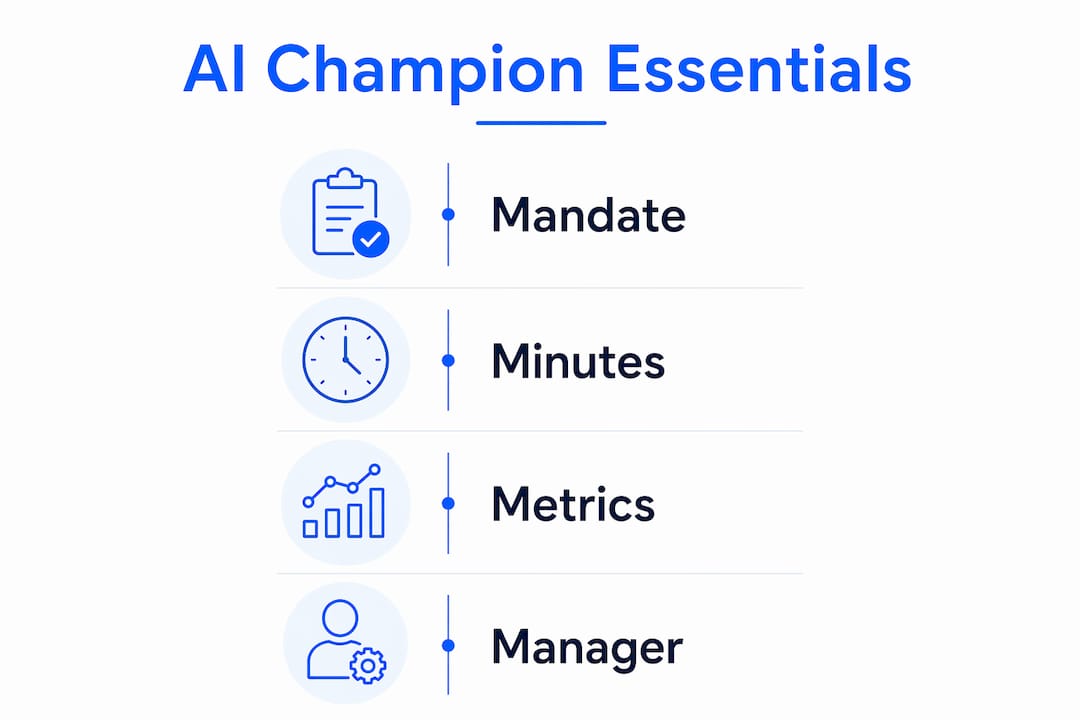
The 4M framework captures the structural conditions every champion needs: Mandate (formal role scope), Minutes (protected time allocation), Metrics (workflow-linked impact measures), and Manager Sponsorship (line-manager co-ownership). Remove any one of these and the program degrades toward volunteer work.
Key challenges in AI adoption that AI champions are built to solve
Most AI adoption failures share a common shape. A pilot succeeds in one team, generates internal momentum, earns a board slide, and then quietly fails to spread. The technology worked. The organization did not change around it.
Several specific barriers drive this pattern:
- Pilot isolation: AI use cases prove out in controlled conditions but never get embedded into the broader workflow where they would actually change unit economics
- Absent standards: Without a champion enforcing consistent practices, every team member uses AI differently, making quality control impossible
- Governance gaps: AI transformation creates accountability that digital transformation never required, including output drift monitoring, model accuracy tracking, and human review thresholds for high-stakes decisions
- Resistance without a peer voice: Top-down mandates generate compliance theater; a peer who has already navigated the same concerns is far more effective at shifting actual behavior
- Volunteer fatigue: Programs built on enthusiasm rather than formal mandate lose energy within months as champions absorb extra work with no protected time and no recognition tied to outcomes
Failed AI initiatives carry real financial and reputational costs. Zillow’s AI-driven homebuying division cost the company $300 million in losses and triggered a stock decline of more than 20% when leadership failed to account for the human and organizational factors around AI deployment. The technology was not the problem.
The most common selection mistake is recruiting AI champions based on AI passion rather than process influence. The result is a group that creates content, hosts webinars, and generates visibility while operational teams see no change in their KPIs. Champions chosen for their proximity to critical workflows, not their enthusiasm for AI tools, are the ones who actually move the numbers.
How AI champions drive measurable business value
The mechanism through which AI champions create value is specific. They do not improve AI adoption in the abstract. They improve it in the workflows where the business actually runs, and they measure the improvement in terms the business already tracks.
The metrics that matter are workflow-level:
- Process coverage: the share of critical workflows with an active champion embedded
- Quality delta: improvement in first-pass output quality after AI integration
- Rework delta: reduction in revision cycles and correction loops
- Manager confidence score: whether line managers can name what changed in day-to-day execution
- Barrier resolution speed: how quickly adoption blockers get escalated and cleared
These metrics separate programs that generate educational activity from programs that change how work gets done. Without formal mandate and impact metrics, champion programs reward visibility instead of value, and funding eventually follows the metrics, which means it disappears.
The broader business case connects directly to unit economics. As Fast Company notes, AI transformation is a leadership problem, not a technology problem. The question worth asking is not where the organization uses AI. It is where AI changes the unit economics of the business. Most organizations cannot answer the second question, and that is precisely the gap AI champions are positioned to close.

Skill development is another lever. Champions build capability in the teams around them, not just in themselves. Their job is to raise the floor of AI competence across a function, not to create an elite layer of experts. When that works, the organization shortens the path from inspiration to standard practice, and the gains compound across teams rather than staying isolated in one high-performing pocket.
How to find and cultivate AI champions in your organization
Start with the workflows, not the people. Map the processes where AI could most directly change quality, speed, or cost, then identify who sits closest to those processes and has the trust of the people working in them. That person is your candidate, regardless of their current enthusiasm for AI.
Effective champion programs use a deliberate composition. Champions should be drawn from a balanced mix of high-volume operational roles, managerial roles accountable for quality and review, and enabling functions like IT, data, and HR. That distribution scales execution across the organization rather than concentrating AI knowledge in central teams.
Every champion needs a formally agreed role package:
- Process scope: which specific workflows they own
- Quarterly targets: linked directly to process-level metrics, not activity counts
- Protected capacity: a defined portion of their time reserved for AI work
- Manager sponsor: a line manager who is a co-owner of outcomes, not just an approver
Training should go well beyond tool literacy. Champions need facilitation skills to drive practice change in teams, coaching capability to support real use cases on the job, and role-specific AI governance knowledge covering what is allowed, what is prohibited, and how to escalate edge cases. Tool training alone produces demo experts. It does not produce change leaders.
Governance structure prevents the program from drifting into a fan club. That means a shared knowledge repository for prompting standards, validation checklists, and lessons learned; a weekly rhythm for capturing team barriers and quality signals; monthly cross-champion calibration sessions; and quarterly portfolio reviews to scale or retire practices based on process outcomes. Rotating a portion of champion roles every 6–9 months in selected areas, and publishing transparent selection and evaluation criteria, keeps the program from being perceived as a privileged circle.
For organizations beginning this work, integrating AI without deep technical skills is more achievable than most leaders assume, especially when champions are embedded at the workflow level from the start.
Research confirms the AI value gap that champions close
The data on AI transformation success rates is sobering. 88% of organizations use AI in at least one business function. Only 7% achieve widespread value realization. That gap does not close by adding more tools or running more pilots.
Only 7% of organizations that use AI achieve enterprise-scale value realization, despite 88% having AI deployed in at least one function. The difference between those two groups is not technology. It is the operational infrastructure around adoption, and AI champions are the core of that infrastructure.
Harvard Business School Professor Karim Lakhani, who co-teaches the HBS Online course AI for Leaders, frames the problem clearly: organizations are experimenting and testing, but they have not fully integrated AI into their workflows, creating a growing gap between what the technology can do and how it is actually being used. That gap is exactly what AI champions are designed to close.
The research on what makes champion programs fail is equally clear. Programs built without formal mandate, protected time, manager sponsorship, and workflow-linked metrics consistently produce the same outcome: educational activity without organizational change. After a few months, energy fades because the program is not tied to accountability for outcomes.
The AI transformation leadership challenge is not primarily technical. According to a 2024 survey, 91% of large-company data leaders identified cultural challenges and change management as the primary barriers to becoming data-driven. Only 9% pointed to technology. AI champions are the organizational response to that 91%.
For leaders building the AI transformation strategy that connects pilots to enterprise value, the structural lesson is consistent across the research: champions work when they have real mandate, dedicated time, measurable outcomes, and line-manager support. Without those four conditions, the program becomes an enthusiast club that inspires but does not change processes.
Key Takeaways
AI champions drive enterprise-scale AI value by embedding formal mandate, workflow-level metrics, and manager co-ownership into every stage of the adoption process.
| Point | Details |
|---|---|
| The AI value gap is real | 88% of organizations use AI, but only 7% achieve enterprise-scale value realization. |
| Champions are operational, not inspirational | Effective AI champions hold formal process scope, protected time, and workflow-linked KPIs, not just enthusiasm. |
| The 4M framework is the design standard | Mandate, Minutes, Metrics, and Manager Sponsorship are the four conditions that separate programs from enthusiast clubs. |
| Probabilistic AI requires ongoing oversight | Unlike rule-based software, AI systems need continuous quality monitoring that only champions close to the workflow can provide. |
| Selection criteria determine program outcomes | Champions chosen for process proximity and team trust outperform those chosen for AI passion alone. |
Ready to embed AI where it actually changes your business?
Botiqueai builds the AI infrastructure that gives your champions something real to work with. From custom AI automation that integrates directly into your existing workflows to intelligent agents designed around your specific processes, Botiqueai helps organizations move from pilot to operational standard.
If your organization is serious about closing the gap between AI investment and business impact, explore Botiqueai’s AI solutions and see how purpose-built tools support the champions driving your transformation.